
Featured

Should you have a legal right to disconnect?

Hola!

I’ve always found it difficult to switch off. It’s probably the root cause of all my stress and anxiety. So maybe having a right to switch off enshrined in law might make me more likely to pay attention. After all, I’m a stickler when it comes to the law.

This pandemic has done nothing for our work-life balance. What life? Between March and May 2020, I spent 51 days in my flat in Barcelona. I didn’t step over the threshold once. During this time, I became even more of a workaholic. If I wasn’t eating or sleeping, I was working. Work has always been an escape for me. If I ever needed a distraction from everything else in my life, my studies and now my career has always been the perfect distraction. I needed to pass the time for 51 days and try and forget about a global pandemic and the fact that my family and most of my friends were in other countries, and I couldn’t get to them. What better way to do that than immerse myself in the intricacies of translation between the French and English legal jurisdictions. I also decided to design my website during lockdown after buying the domain name the previous year and just not getting round to it. There’s nothing like a global pandemic to ensure that you’ll have plenty of time on your hands.

While employed in the legal profession, I didn’t have a company phone, so I wouldn’t have dreamed of having my work emails on my personal phone. Data protection and client confidentiality aside, I only used my phone when I wasn’t working, so it would have made no sense to have it pinging left, right and centre when I was out of the office. After any annual leave from my day job, checking my emails was always a mammoth task and the thing I dreaded most about returning to the office. It genuinely gave me heart palpitations when I had a few hundred emails to read through, mainly comprising generic firm emails or those trying to find the owner of some funds that credited the client account two weeks ago. Fast forward seven years, and I had my emails on my laptop, iPhone, and iPad. I literally couldn’t escape them. Sometimes it seemed like the personal and professional parts of my day were blurred, especially as most professional activities now seem very personal to me as a small business owner. My business is my baby. How the tables have turned! Now, I wouldn’t dream of not having my work emails on my phone. Who else will reply to my clients? It’s this nagging concern that often drove me to check my emails incessantly. I’ve always had severe FOMO in all aspects of my life, and work is no different. What happens if I miss that important email from an existing client? What happens if I don’t respond immediately to an enquiry from a new client? The world won’t end, but sometimes we think it will.

As freelancers, we’re able to develop our own habits to our heart’s content. But unfortunately, we don’t always develop good ones. I realised that I was developing some harmful habits, and I needed to nip them in the bud. Recently, I’ve been developing some healthier habits to help me to try and switch off more and reduce my blue light exposure. Here are a few things I’ve started doing that have helped me to switch off and reduce my blue light exposure in the process:

  • I switch my phone off at 8 pm every night so that my brain and my body know it’s time to relax and start winding down for bed.
  • I don’t have any work emails on my phone, so I have to physically get up and go to my laptop to check my work emails. This is particularly handy for minimising distractions during coffee and lunch breaks.
  • When I’m out of the office on holiday, I only check my emails at midday every few days to appease the workaholic in me and give me the peace of mind that the world hasn’t ended while I’ve been away. It also helps me feel less anxious about opening my emails for the first time when I get back to the office.

I’ve found that removing my emails from my phone has really helped me unplug because they were just distractions. I’m human, and I can’t always drop everything at the drop of a hat, especially when I’m trying to grab some much-needed lunch in between back-to-back client calls, translation work and teaching legal English. I’ve been more conscious of this since having a proper Christmas break without emails, and it’s now a practice I will adopt permanently (unless I’m on the move). I was developing an unhealthy relationship with my emails and checking them all the time, so I knew I needed to kick the habit.

The pandemic didn’t change my working from home life very much, but I can imagine it was quite a shock to the system for those used to working in an office. According to The GuardianEU research shows that the percentage of people who started to WFH full-time rocketed from 5% in 2019 to almost 40% last spring. And as a result, the work-life balance is officially all out of sync. This pandemic has completely changed how some professions work. Previous employers who wouldn’t have dreamed of allowing their employees to work from home before have now embraced it with open arms. Something I thought the legal profession would never do.

I’d never heard of Zoom fatigue or Zoom for that matter until April 2020, when I attended the BP 20 Translation Conference, which was online, of course. This four-day event was fantastic, but it was still surprisingly tiring and watching and listening to a computer for four days certainly took it out of me. Hence, Zoom fatigue. It’s real. Take it from me.

Now I’m going to throw some stats at you. Be warned, they are terrifying!

  • A Harvard study that analysed the emails and meetings of 3.1 million people in 16 global cities found remote staff work 48.5 minutes more per day.
  • Eurofound’s data suggests that far from “shirking from home”, those remote staff are twice as likely as office-based workers to be exceeding the EU’s 48-hour working week.
  • Almost a third of the remote army work in their free time several times a week – compared with fewer than 5% of office workers.
  • Further research published found employees working from home in the UK, Austria, Canada, and the US are at their computer an extra two hours a day.

Wow, that blew my mind but, I’m not that surprised. I’m probably part of the problem. Also, I love the term remote army. What a great way to describe us!

I just don’t think that employment law was ready for this pandemic. Who was? Take “furlough”, for example. The word or the legal concept didn’t even exist in English employment law until the pandemic hit. We had to look to the US and countries with civil law systems such as France to find an employment concept to support employers and employees across the country. The changes brought about in the way we work, including remote working, have revolutionised the digital workplace’s legal implications. Employment law needs to catch up and fast, particularly with anxiety, depression, interrupted sleep patterns and burnout rising among the remote army. And we all know that checking emails and keeping devices on is a massive contributing factor to this. It’s time for employment law to get real.

Did you know that those who work remotely have no right to switch off outside working hours under EU law? Regardless of Brexit, EU law will still impact our domestic law to a certain extent as we have complied with it for so long, and if we didn’t, we would find ourselves unable to keep up with future employment practices in the EU Member States. The EU’s Working Time Directive stipulates minimum daily and weekly rest periods, and work-life balance is one of the 20 principles enshrined in the European Pillar of Social Rights, but you don’t have a right to switch off.

We find ourselves needing to adapt the law to the new world that we live in. In January, the European Parliament voted overwhelmingly in favour of a resolution calling on the European Commission to propose a law allowing remote workers to disconnect outside their working hours.

French law is way ahead of this new trend. Twenty years ago, France introduced a 35-hour working week limit for companies with more than 20 employees and then extended this to smaller companies. This practice paved the way for a ruling in 2004 by France’s Cour de Cassation against an ambulance company’s decision to fire a driver for not answering his personal phone outside of working hours. Since then, BNP Paribas and Orange have introduced rules against contacting employees outside of their working hours. In 2017, France introduced a law that required companies with more than 50 employees to draw up a charter that set out times when staff should not send or answer emails, creating the world’s first “right to disconnect” law. However, France’s legislation is often non-binding in the event of disagreement to sign a charter.

As with translation, cultural references also have a role to play in employment law. Naturally, employment practices will differ from country to country. What is appropriate for one country may not be suitable for another country. A Polish expat living in France referred to the lunch break as a sacred entity only to be missed if there was a war or earthquake. That’s quite a bold claim. My lunch break experience in English law firms taught me that the lunch break was very much discretionary. In years gone by, I sometimes ate my lunch at my desk or skipped it altogether. Why do you think I moved to Spain? Although now I’m freelance, I’m free to do what I like, when I want anyway. Although the French law may not be as enforceable as its critics would like, it certainly supports a different work culture.

Other EU countries have also jumped on the bandwagon and considered the “right to disconnect”. Canada, India, the Philippines, and the United States have also considered where employees stand. It seems that the UK is way behind the times.

I think the “right to disconnect” is a good one, and I’ve already implemented it in my business because I’m free to do so as a freelancer. Suppose I don’t reply to a client email at the weekend. Maybe the client will be happy that they’ve chosen a professional who has a life outside work. Perhaps, receiving an answer at the weekend might even wreak of desperation. It also sets a dangerous precedent if I reply at midnight or the weekend. It’s all about managing my client’s expectations. I’ll go above and beyond for my clients, but I’m no use to them if I’m burnt out. They deserve a healthy, focused, and better version of me.

However, often employees don’t have the luxury of flexibility, and they rely on employment legislation to shape their working practices. As with any law, there’s always a danger it won’t be flexible enough for the entire workforce. If I want to work past 5 pm, I should be able to, and if I want to swap a weekday for a Saturday or a Sunday, I should be free to do so. I’m a freelancer precisely so that I’m in charge of my destiny, and I don’t have to work nine to five. I’m sure the parents trying to work between home schooling and looking after their children would also appreciate flexibility when they log on and off, which law might not be able to offer.

I believe in the “right to disconnect”, but I’m not sure a legal right is the answer for the remote army. It’s up to us to build healthy, not harmful, habits.

I would love to hear about your healthy (and harmful) habits in your home office. You can find me on all the usual social media hangouts or drop me an email at info@coleytranslates.com. Get in touch. I don’t bite, I promise!

Legally ginger,

Nicole

Featured

To certify or not to certify a translation, that is the question!

Hola!

When someone asks me if I’m a sworn translator, I immediately dust off my trusty template response file. This response explains how I’m a certified translator, but I can’t possibly be a sworn translator because they don’t exist in my jurisdiction. If I had a pound for every time someone has asked me this question, I’d be a rich woman. In fact, I’d probably be writing this from the Seychelles rather than a sleepy Yorkshire town.

When you use my services, I always try and educate you as much as I can about the industry. You’ll thank me for it in the long run because next time you need a translator, you’ll know what service to ask for, and ultimately, you’ll be able to get the job done quicker. Knowing what you want makes your life easier as you get the service you need and deserve, and it makes my life easier because I can deliver a flawless translation that’s fit for purpose.

I hate to break it to you, but sworn translators don’t exist in England and Wales, and it’s my job to explain that you won’t find this mythical being, even on the darknet (educated guess). However, many people throw around “sworn” and “certified” translation services interchangeably for various reasons, but this confuses people. Perhaps you’re used to sworn translators in your jurisdiction, or maybe you’ve been advised that you need a sworn translation, when in fact, a certified translation would suffice. Misinformation can seriously confuse you because you simply don’t know where to turn for the right service. Fear not, I’m here to expel some myths and arm you with a toolkit to get the certified translation of your dreams so you can get hitched or settle your Brexit status. You’ll end up with a translation that ticks all the boxes.

I recently received an enquiry from a Spanish colleague whose client required a “sworn” translation of their PhD certificate and related documents from French into English. After digging a little deeper, they didn’t require a “sworn” translation. They needed a “certified” translation. I found this out within minutes of the initial email because I knew the right questions to ask. By asking for more information about the translation’s purpose and the requesting party, I provided crystal clear advice. Until I know what you need, I don’t know what service is right for you.

This is probably the start of something beautiful. But first, make sure you’re clear on what exactly the requesting party needs from you. What are the requirements of the translation? You don’t ask. You don’t get.

Once you’re clear on their expectations, you’ll know what you want, and it’s always so much easier to get what you want in life when you’re clear on what that is. If you’ve never needed a translation for official purposes before, it isn’t easy to know the right questions to ask. Don’t worry. I’ll let you into a little secret. I know the right questions to ask, and soon you will too.

First things first, what do you need it for, and what is the purpose of your translation? The purpose of the text has never been more critical. So, make sure you check with the requesting party exactly what they intend to do with the translation. Once you have the correct information, you can then provide me with a clear brief, and you can breathe a sigh of relief while I crack on. The purpose can differ drastically according to the requesting party or use. If in doubt, I always ask my clients to check with the relevant authority or person requesting the translation precisely what they require in writing. And if they require a certified translation, we’re in business. It’s imperative to ask the relevant authority or person requesting the translation for their requirements. If there’s a problem with the translation you provide, you’re covered as you’ve asked the right question in writing, so they won’t have a leg to stand on.

Translators will also really love you if you give them plenty of time to complete, certify and post the translation to you, so you both avoid any sleepless nights. Get in touch with me as soon as possible so that we can get the ball rolling. I charge more for a certified translation as it requires more work; the translation itself, extra administrative tasks, certification, and postage are all reflected in the price. I’ll be very transparent about the cost from the start, and we’ll agree on this before certification. If we get this right, your certified translation will be signed, sealed, and delivered in no time.

So, what’s the difference between a certified translator and a sworn translator? All you need to know is that only the former exists in England and Wales.

Unlike many EU countries, the UK does not have a system of “sworn” or “certified” translators accredited by a particular body. Translations required for official purposes, such as birth, death and marriage certificates, legal documents, academic transcripts etc., can be self-certified by any practising translator, including members of the Chartered Institute of Linguists (CIOL) like me.

However, guidelines frequently stipulate that a “certified translation” should be prepared by a professional body member, such as the Chartered Institute of Linguists (CIOL) or the Institute of Translation and Interpreting (ITI). As I’m a Member of the CIOL, your documents are in safe hands.

Please note that certification does not guarantee the quality of a translation but identifies the translator and their credentials and makes them accountable for their work. Using a qualified professional is vital for translations required for official purposes, but the requirements for a certified translation vary depending on who needs it.

The UK government says:

If you need to certify a translation of a document that’s not written in English or Welsh, ask the translation company to confirm in writing on the translation:

  • that it’s a ‘true and accurate translation of the original document’
  • the date of the translation
  • the full name and contact details of the translator or a representative of the translation company.

Whereas HM Passport Office gives this advice:

Where a document written in a foreign language is submitted in support of a passport application it should be submitted with an English translation attached. It should be provided by a translator registered with an official organisation such as the Institute of Linguists or the Institute of Translation & Interpreting. A translator who is employed by a recognised Translation company, the latter being a member of the Association of Translation Companies, is also acceptable.

As you can see, the requirements differ slightly depending on who’s asking. So, the moral of the story is: always quiz the requesting party. Then, I have all the information I need to deliver an end-product fit for purpose.

What do you get for your money? Once I’ve translated your document(s), I’ll attach a letter on company letterhead confirming that a qualified translator (otherwise known as me) has translated your document in a format and wording approved by the CIOL. It includes all my credentials, including my membership number, so you or the requesting party can check that I am who I say I am.

I will also initial and stamp each page of the translation to prevent any tampering or misuse. My initials, coupled with a personalised stamp, will clarify that I’ve certified this translation for you and no one else. I’ll also sign it to certify that the document is a true, faithful, and accurate English translation of the French document. Signed, sealed, delivered, and it’s yours!

You’ll receive a hard copy with a few little freebies, including a little card, a cheeky discount code and a few edible goodies. These are to say thank you for choosing to support my small business. I genuinely do a happy dance when you buy from me, but luckily for you, you don’t have to witness that.

So, there you have it, a certified translation in all its glory, and you can now marry, divorce, or avoid whoever you like. I hope this has helped debunk a few myths about certified and sworn translations because there is a lot of fake news out there. In fact, I’m surprised Trump didn’t tweet about certified translation at some point before he was banned.

As a member of the CIOL, I can help you if you need a certified translation from French to English. You even get chocolate! Or, if you require another language combination and you’re not sure where to turn, I have a network of trustworthy translator pals that will save the day. Ask away!

You can find me on all the usual social media hangouts or drop me an email at info@coleytranslates.com. I don’t bite, I promise!

Legally ginger,

Nicole

Featured

Is AstraZeneca doing its best to supply the Covid vaccine to the EU?

Hola!

The question on everyone’s lips now is when are we going to receive that much-anticipated jab in our arms? Given the ongoing dispute regarding AstraZeneca’s contractual obligations under the EU-AstraZeneca contract, that jab in your arm might take longer than anticipated if you’re an EU citizen.

Facts of the case

  • The EU signed an advanced purchasing agreement with pharmaceutical company AstraZeneca (AZ) in August 2020 ahead of the release of the working vaccine.
  • The EU ordered 300 million doses of the vaccine for delivery after the vaccine was approved by the regulator. There was also an option for 100 million more.
  • The EU approved the Oxford-AZ vaccine on Friday 29 January 2021.
  • EU sources say they now expect to receive only a quarter of the 100 million vaccines expected by March due to production problems at AZ plants.
  • This contract is governed by Belgian law.

So, I think it’s safe to say that the EU aren’t happy about this situation as it has a direct impact on EU citizens. They believe that AZ is not upholding its side of the bargain. The EU has asked AZ to send some doses manufactured in the UK plants to the EU Member States to make up the shortfall, but according to AZ, the earlier contract that they signed with the UK regarding UK supplies of the vaccine prevents this.

Ursula von der Leyen, the President of the European Commission, thinks that the EU has a clear-cut case as these are “binding orders and the contract is crystal clear”. But after analysing the contract myself and reading extensive commentary by other lawyers, I’m not so sure I share her enthusiasm. Things are rarely that simple when it comes to the law and I don’t think this is an open and shut case.

Like many cases, this will require specialist legal interpretation and some lengthy discussions about the meaning of the relevant clauses to determine who is right. While I specialise in English and French law and not Belgian law, drawing comparisons between the two jurisdictions can still be useful to try and determine how this contract may be interpreted in other jurisdictions and ultimately, under Belgian law.

After the European Commission’s request on 27 January 2021, AZ agreed to publish the redacted contract on Friday 29 January. Commercial agreements such as this are private documents and normally eyes only. Unfortunately, the European Commission released an unredacted copy of the EU-AZ contract first (oops!) before releasing the redacted version which omitted any sensitive commercial information.

Some think that the EU hoped that publishing the contract would strengthen their case but I’m not so sure about that because as one source points out, “neither side would have published this if either side thought it was legally conclusive”.

When I first cast my eyes over the redacted contract, I immediately found myself immersed in legalese and wondered that, perhaps, if we adopted a plainer English approach to drafting contracts, this might all have been avoided and EU citizens would be getting that much-needed vaccine much quicker.

After analysing the contract and picking it apart, I must say that I’m still on the fence. It really is open to interpretation. And I’m not the first lawyer to say that.

Any breach of contract claims and lengthy litigation aside, the EU’s issue, in a nutshell, is that they can’t get their hands on enough of the vaccine. That’s what it boils down to and that is affecting people’s lives. In a global pandemic, time is of the essence and any delay in administering the vaccine is precious time indeed.

What are AZ’s obligations under the contract?

The contract stipulates that AZ must make its “best reasonable efforts” (BRE) to meet EU demand for the supply of the vaccine. But what constitutes BRE? Luckily, it’s defined within the contract itself. Bingo, this should be straightforward right? No, it isn’t. This is where the parties’ lawyers start to argue about what that definition itself means. According to the contract, BRE in AZ’s case means:

 the activities and degree of effort that a company of similar size with a similarly-sized infrastructure and similar resources as AstraZeneca [that is AstraZeneca AB] would undertake or use in the development and manufacture of a Vaccine at the relevant stage of development or commercialization having regard to the urgent need for a Vaccine to end a global pandemic which is resulting in serious public health issues, restrictions on personal freedoms and economic impact, across the world but taking into account efficacy and safety.

There’s still some room for interpretation here wouldn’t you agree? The contract is governed by Belgian law but under English law, whilst there isn’t a clear-cut breach of the BRE obligation, it would turn on the evidence of what you would expect from a $9 billion company. And I think we can all agree, you would expect quite a lot. A company of its size with production facilities across the world should be making a reasonable effort to stop the significant shortfalls in Europe.

However, BRE in a global pandemic are also not straightforward. These are not normal times that we live in, which ironically is the reason that these two parties have contracted with one another. Some lawyers have suggested that the definition of the term in the contract itself does allay to a commitment that may be bigger than that generally expected in a standard commercial agreement. As I said, these are not normal times so should the contractual obligation require a ‘normal’ response, or should they be going above and beyond?

For commercial contracts under English law, ‘best reasonable efforts’ is often a drafting compromise because one party stipulates the “best effort” and the other stipulates “reasonable efforts”. Therefore, the compromise of ‘best reasonable efforts’ or ‘reasonable best efforts’ was born. But none of these usually amount to an outright obligation.

Even though BRE is a defined term in the EU-AZ contract, it’s not as specific as the wording in the Curevac-EU vaccine contract where the definition of reasonable best efforts is “a reasonable degree of best effort to accomplish a given task”. This is much clearer and imposes more of an obligation.

The delivery deadlines have been redacted from the contract, but Clause 5.1 stipulates that AZ shall use BRE to manufacture the “Initial Europe Doses” within the EU within a redacted timeline. The EU is arguing that AZ should be using its UK plant to meet EU demand. The contract only refers to manufacture in the EU.

Clause 5.4 is concerned with Manufacturing Sites and it states that AZ must use BRE to manufacture the vaccine within the EU and the UK. A literal interpretation would suggest that AZ must use the degree of effort that a company like AZ would use to manufacture in both the EU and the UK and must use the same level of effort to manufacture the Initial Europe Doses within the EU. However, the contract does not say that AZ must use efforts to manufacture the Initial Europe Doses in the UK. That being said, would be it reasonable for them to manufacture in the UK plant to meet EU demand?

Another bone of contention here is that AZ signed a deal with the UK Government for 100 million doses three months before the EU deal was agreed. In a post-Brexit landscape, this isn’t helping UK-EU relations. Especially when the EU took the initial decision to trigger a Brexit deal clause to place controls on the export of vaccines before backtracking last week.

I think that the EU will also seek to rely on Clause 13.1(e) because AZ says that it’s not under an obligation to anyone else (like the UK) “in respect of the Initial Europe Doses” or that conflicts with the agreement. However, AZ may argue that this was true when the contract was signed and that it has since made BRE to manufacture the vaccine but there are no guarantees.

It would be remiss of me not to point out that the EU Member States are way behind the UK, Israel, the UAE, and the United States in rolling out their vaccine campaigns and I do think this is a relevant factor here. Any drawn-out legal proceedings will do nothing to improve the situation. Both sides have acknowledged that parts of the contract would be for a judge to rule on which is certainly not an ideal scenario. Let’s hope both parties will arbitrate rather than litigate to prioritise the lives of EU citizens and roll out the vaccine campaign as soon as possible. Litigation certainly wouldn’t be the right way to go about that and with concepts such as “vaccine nationalism” being thrown around, I think it’s fair to say that this needs to be resolved very quickly.

But the fact remains, the contract is not clear-cut, and it does leave a lot to interpretation. As a language practitioner, I’m always interested to know how a situation could be described in another language and James Turner QC, of Quadrant Chambers, who specialises in cross-border commercial disputes provides the perfect example. “There’s an expression in German, which is our equivalent of ‘clear as mud’, which is ‘clear as noodle soup’. And that’s what I think this particular kerfuffle in the contract is. I think this is clear as noodle soup”, and I’m inclined to agree with him.

Clear as mud, clear as noodle soup or crystal clear- the jury’s still out. But I think it’s time for both sides to put their big girl pants on and find a solution and fast.

And I could go on, but I won’t. If you fancy some further reading, have a read of the contract yourself here. I’d love to hear what you think.

I would also love to hear your thoughts on what you’re working on or blogging about and what content you’d like to see on my blog. You can find me on all the usual types of social media or drop me an email at info@coleytranslates.com. I don’t bite, I promise!

Take care of yourselves and drop me a line if you fancy a chat.

Legally ginger,

Nicole

Disclaimer: Anything posted in this blog is for general information only and is not intended to provide legal advice on any general or specific matter.

Featured

War of the Words

Hola!

I think its fair to say that we’re used to international and European leaders talking about a war in different contexts; the war on terror, the war on drugs and 2020 brought the war on coronavirus. Legal definitions aside, it is a war of sorts. As a dedicated word nerd, I compel someone to find a better alternative to describe the situation that we are faced with. Sure, we can throw around some synonyms such as “battle” and “fight” but ultimately, this is a war! But it’s one we can win. Together!

This isn’t a political blog post. I don’t wish to impose any politics or agenda on my readers, I’m just a word nerd and a lawyer who finds language use and the law of armed conflict and international humanitarian law simply fascinating. I think it’s important to make a clear distinction between the legal definition of war under international law and the coronavirus pandemic. This blog post isn’t about whether the use of the word “war” is right or wrong, but simply to explore how it’s used and its effects. Love it or hate it, I can understand why this word has been coined to describe the pandemic.

The idea for this blog post came to me after an interesting lesson with one of my legal English students. My student is a lawyer and a former French MP currently writing his PhD thesis, so I think it’s fair to say that he’s opinionated, something I can completely relate to. Have you ever met a lawyer who didn’t love a good argument? No, me neither. This student and I often put the world to rights and this day was no different. We analysed the language used in speeches given by British Prime Minister, Boris Johnson and the French President, Emmanuel Macron towards the beginning of the lockdown period back in 2020. Being a word nerd, peoples’ choice of words is fascinating and the talented speechwriters behind these politicians chose their words very carefully for a specific purpose. The French approach was much more direct with the repetition of nous sommes en guerre [we are at war] and referring to coronavirus as the “enemy”, whereas the typically British response was much more subtle. The war word didn’t even pass the British Prime Minister’s lips, but he certainly used a lot of other words with connotations of war; “enlist”, “fight” and “battle” to name but a few. I must admit that I preferred the less direct approach as I think the delivery conjured up a sense of duty among the British people for their own nation and the wider world. Perhaps that’s the British bias in me where we are less direct in almost everything we do. The use of language evocative of war is understandable at a time when sticking together (albeit socially distanced) and collective action is the only way to keep our fellow citizens safe.

President Macron and the British Prime Minister weren’t the only ones at war. In March, Chinese President Xi Jinping declared that China would have won the “people’s war” against the coronavirus after visiting the virus-stricken city of Wuhan. Former (so glad I can say that now) US President Donald Trump tweeted (before the ban) that “the world is at war with a hidden enemy”. Probably one of the only sincere things he’s ever said. New York Governor Andrew Cuomo also reportedly said that “ventilators are to this war what bombs were to World War II”. German Chancellor Angela Merkel called for national unity as Germany faced the greatest challenge since World War II. Now, that’s quite something to say. These sentiments were and continue to be echoed throughout Europe and the world with UN Secretary-General Antonio Guterres using similar language. There is certainly a common trend here.

Politicians, academics, and journalists worldwide have evoked war imagery to describe this health emergency. They’ve adopted conflict terminology suggesting a ‘war’ on the coronavirus to stress the lethal nature of this unprecedented threat. Italy was the first European country to experience a serious domestic outbreak of COVID-19 and they’ve since been referred to repeatedly as the ‘front line’ of the coronavirus pandemic. There’s another war word for you. The collective efforts of the world to combat the spread of this deadly disease are constantly portrayed in the media using war metaphors. Have you heard about the health workers who are in the trenches?

I’m not throwing the war word around lightly and I’m in no way likening months in quarantine with most of your home comforts to an armed conflict situation; that’s an entirely different horror to be faced with. And while this may not constitute an armed conflict which fulfils the legal definition of war throughout the world, I do think some parallels can be drawn to help us to understand how we can approach the fight against coronavirus. As a colleague of mine mentioned on a thought-provoking LinkedIn thread, we say that patients “fight” a disease or “win their battle with cancer” so, therefore, it’s not beyond the realms of possibility that something of this scale could be referred to as a “war”. It’s fought on many fronts worldwide, it’s resulted in a devastating death toll, it’s separated loved ones, it’s interrupted life as we knew it, there are shortages and not to mention the disastrous effects on the economy. These effects aren’t dissimilar to the effects of war.

I think few people would disagree with the fact that using these metaphors also helps people understand the gravity of the pandemic; the huge amount of deaths worldwide all killed by a common ‘enemy’ is certainly very characteristic of war. Unfortunately, some people haven’t understood the gravity of the situation and have continued to put themselves and their families at risk, but if the use of the war word doesn’t spur them into action then what will? In war, I imagine that you often feel a sense of duty, whether it be to your country, your religion, your cause, your family etc. and at the moment, we need people to take this seriously. What’s more serious than war? We need people to do their duty, play their part and fight for their countries, and together we’ll recover from this.

It isn’t the first time that global pandemics or catastrophe have been described using words of war and unfortunately, I doubt it’ll be the last. However, coronavirus is no ordinary enemy and it knows no boundaries. It transcends gender, age, race etc., no one is immune; just like when you’re at war. The metaphor of war also conjures up an image of the worst atrocities possible and while the hospitals flooded with the sick and the dying is evocative of war, it doesn’t constitute war in the legal sense. However, perhaps healthcare workers and other frontline workers would disagree because in war, health care workers are protected, and they even care for the enemy. However, in this war, is PPE providing the same protection as the law does in war? Now there’s a question for you.

The power of words never ceases to amaze me. Words and war have the power to make people go into battle, to act, to make people win or lose or to stay alive. Wars are part of our shared identity and they awaken ideals of duty, personal responsibility, hope, and faith. They also inspire endurance and sacrifice. But everyone loves a winner, so stay home and stay safe.

I would also love to hear your thoughts on what you’re working on or blogging about and what content you’d like to see on my blog. You can find me on all the usual types of social media or drop me an email at info@coleytranslates.com. I don’t bite, I promise!

Take care of yourselves and drop me a line if you fancy a chat.

Legally ginger,

Nicole

Featured

Money talks and so should we

Hola,

Money makes the world go round. Or so they tell me. And after 28 years of using money, it doesn’t grow on trees.

The importance of money was instilled in me from an early age. Always save for a rainy day. Maybe that rainy day could be a global pandemic or just a quiet time of year.

My Dad was born in the sixties in a small Yorkshire town to two working-class parents. After contracting polio as a youngster, his father was left permanently disabled for the rest of his life. However, that didn’t stop him working extremely hard to provide for his family, despite any obstacle that he faced. He was a cobbler and certainly instilled in my Dad the importance of a good pair of shoes. You wouldn’t believe how careful I am when I buy a new pair of shoes because I know at some point, they’ll be inspected by my Dad and they’ll need to pass the test. Few do.

My Grandfather’s work ethic was instilled in my Dad from a young age and I’m sure that this played an important role in my Dad being the first in the family to attend university and later go on to build his own estate agency business from scratch. I owe so much of my work ethic to my parents. I wouldn’t be who I am or where I am today without that work ethic.

I’ve worked since I was 13 years old but when I finished my undergraduate degree, I was eager to start earning some real money and get my ducks in a row. This was when I first encountered someone who wanted to stop me from getting on in life by controlling me through money. At one of the law firms I worked at, I had a manager who tried to pay me less than everyone else not because I was young and relatively inexperienced at that point, but because I had some good experience, I was over-qualified for the job and she didn’t like ambitious women. She even told me that I wasn’t allowed to discuss my salary with anyone else. That old chestnut. That was her way of trying to control me, but I know my rights, better than her considering she had no legal qualifications and no people skills either.

I didn’t listen to her because I knew how hard I was working, I knew how much my clients valued me and I knew that I was the only member of the team who had the inclination or the skills to draw up trust documents. This was the first time I openly discussed my salary with my colleagues and friends and as a result of a united front to discuss our salaries at the time, there is now a detailed pay structure in place at this firm (so I hear). The message here is a clear one- united we stand.

However, we can’t be united if there is no transparency. We need to be in the know. We need to know what other translators are charging for their services so that we all know, as a profession, whether we are charging enough for our work. That’ll help us to improve pricing structures in the profession as a whole. Concerns about “bottom feeders” who have extremely low rates can do serious harm to the profession by undercutting other professionals, especially if they are providing subpar service. I’ve always believed that you get what you pay for and there is a reason that you pay more for a highly qualified, articulate, professional translator rather than the weekend linguist who can get by with a few words of French on their summer holidays.

So, let’s talk about money, money, money. I first started thinking about the need to discuss what we charge after a fantastic talk from Chris Durban in 2019. I really like her no-nonsense approach to rates and her evident success in tapping into the premium market. This was the first time that I had witnessed anyone openly discussing rates in a room full of translators. Many see it as a taboo subject and don’t feel comfortable discussing it. I would never want to make anyone feel uncomfortable and it’s completely your prerogative whether you discuss your rates with anyone but your office pet. But I urge you to give it a try and have a good natter about it with your most trusted colleague. What have you got to lose…or more importantly, gain? Just imagine if you did talk about it and you realised that you were charging way below what you should be? Now I have your attention.

During Chris’s presentation, we completed an exercise where we worked in pairs to quote for an urgent, yet delicious lobster recipe for a major financial conference. Apart from making us all extremely hungry, it made us think about why we charge what we do and how we justify this to our clients. You would not believe the disparity in the rates, it was HUGE. Think as low as you can go to the dream fee. It couldn’t have been more different. I looked around the room to see twitching translators everywhere because we were discussing money. However, when we all realised how much we were all charging and why it created a fantastic topic for a conversation about why the lowest rates were just too low and how and why we should and could achieve the highest rates. That’s not to say that we should all charge the same, the market needs competition and variety in pricing for the huge variety of clients that we, as a profession, work with and the variety of services and expertise that we offer. An associate at a city law firm won’t be charging at the top end of the hourly rate scale to close that all-important deal, whereas a partner will. Newbie translators have less experience and perhaps fewer qualifications so it’s only natural that the wisest and most experienced translators will differentiate themselves from the crowd on price. Nonetheless, it certainly opened our eyes to new possibilities when we talk about money. So much so that the following week, I increased my rates. And more importantly, it made us all feel more comfortable about talking about money if we should choose to do so.

Since then, I’ve always really respected those in the industry who’ve been willing to talk about the elephant in the room when providing advice to newer members of the profession. Take Corinne MacKay for example, she even tells you how much she earned in her first year of freelancing. How useful is that?! Let me tell you, it’s crucial if you’ve just completed your first full year of freelancing and you need something to compare it to. Now I’m paraphrasing here, but she also thinks it’s really important to tell her peers what she earned then and what she earns now so that others can learn from that, believe that they can also achieve that and understand the context in which she is offering this advice. How refreshing!

Recently, I’ve noticed that a few translators even provide their rates on their websites. Now that’s not for everyone but that, coupled with a few conversations with some trusted colleagues, got me thinking about why we don’t talk about rates more often. I can tell you first-hand that in the legal profession, your hourly rate is like a badge of honour. Your high street solicitor will tell you their hourly rate, as will your magic circle Partner before you even discuss the legal matter and this rate may send a shiver down your spine. When I worked in legal practice, I used to tell my clients my hourly rate in my engagement letter and when I billed them every month and to practice what I preach, my hourly rate was £111 back then. That was five years ago, before a master’s at a top university, a whole heap of professional skills and plenty more life experience, but what am I worth now?

So, why is it that we don’t have the same attitude in the translation profession? We offer a professional service that’s just as important. For example, a French company and a British company can’t do the deal if they don’t understand the terms and conditions which will govern their contractual relationship. A translator facilitates international business, like this and in many other ways. Money makes the world go round, but translators allow you to connect with that world. And that’s where I come in. I know my value and even a global pandemic can’t diminish it. Maybe my value has even increased if I can ensure that coronavirus-related material is correctly translated and saves lives. I know the value of money and I’m still trying to reflect this in my rates.

A recent conversation with a trusted colleague of mine who translates from English into her native Spanish prompted me to write this blog. She is much more experienced than I am, but she was also of the opinion that we need to talk about money much more within our industry. She was even kind enough to tell me that she certainly wouldn’t take any less than €0.10 per word for a legal document. Now we’re talking! This gives you a starting point, rather than just stabbing in the dark and plucking figures out of thin air. I completely agree with her and it gave me the peace of mind that I wasn’t stabbing in the dark either. Just a ballpark figure or a bit of information can help you to structure or re-structure your pricing strategy.

One of the many reasons why I recently embarked on Susie Jackson’s Charge with Confidence course was because it concerned money and it sounded like the perfect opportunity to talk about money, with other like-minded translators. Forums to talk about money with other freelancers, particularly translators, is a rare opportunity so I grabbed it with both hands. I suggest you do the same and check out Susie’s fantastic course here.

On this course, we created two hourly rates: a minimum hourly rate which would pay all of our bills and an aspirational rate which would allow us to live our best lives. The beauty of this course is that we all agreed that one size does not fit all. We all have different priorities; we may want to work a 4-day week with 10-hour days or only work afternoons every weekday. Just like freelancing allows us to work the hours we want and where we want, it also gives us the freedom to charge what we want.

I’ve been lucky enough to find some confidants who I feel comfortable talking shop with. One colleague even told me that after attending a conference a few years ago, she was left reeling when a fellow translator explained that her hourly rate for some clients was €60 and €90 for other direct clients within a certain sector. And this was a few years ago. Stories like this aren’t uncommon but the fact that they can identify real disparity in rates means that it’s vital that we talk about them.

My closest confidant works in the industry too and we regularly bounce ideas and quotes off one another. This is reflective of our collaborative rather than competitive mindset, even though we work in the same language pair. This may not be for everyone; you need to find your own way but if it improves the quality of our quotes to our clients and helps us to make a better living then it’s a no-brainer.

Wow, would you look at that? I’ve just quoted actual figures from real translators and I haven’t been struck down by lightning. But let’s not speak too soon, as Storm Ellen has just arrived in the UK and 2020 has been an unprecedented year of pandemics and Trump’s showerhead issues.

I’ll leave you with this. “The closer you are to the money, the better off you’ll be”. So, make sure that the amount of money you’re charging, is the right amount for you.

If anyone feels like they aren’t sure if they are charging what they should be charging and wants to chat, I’ll be happy to have an open and frank discussion with you and it won’t go any further. I take secrets to the grave. Ask my friends. I certainly don’t have all the answers, but I always love to share ideas. Talking about it might not be for everyone but if you want to talk rates, then get in touch and we can put the world to rights.

I would also love to hear your thoughts on what you are working on or blogging about and what content you would like to see in my blog. You can find me on all the usual types of social media or drop me an email at info@coleytranslates.com. I don’t bite, I promise!

Legally ginger,

Nicole

Featured

Black Lives Matter, in every language

Hola,

As you may have noticed, I’ve been a bit quiet recently, which is most unlike me. I’ve spent this time gathering my thoughts and pondering how I can make a difference in the world that we live in. I’ve decided that it’s time to listen to those voices which have gone unheard for far too long. Listen to those voices which we don’t hear enough of. And now is the time for you to find your voice and speak up for your rights and for what you believe in.

After giving it a lot of thought, I decided that I wanted to speak up on my blog about the recent events in the United States and worldwide in relation to the Black Lives Matter movement. It’s my blog and my business after all. As someone who is ‘privileged’ enough to be alive and to be able to stand up for those who aren’t and those who are still fighting oppression, ignorance and downright barbarity, I owe it to my fellow humans to say my piece. So here goes…I’m privileged, simply for the opportunities which I’ve had in life which have allowed me to be where I am today. Opportunities which, for whatever reason, others haven’t had.

As I write this blog post, a press article from the European Parliament’s Committee on Civil Liberties, Justice and Home Affairs landed in my inbox. I’m very lucky that my clients really understand my professional and personal passions. I’ve always been extremely interested in justice. It sounds cliché for a law student, but it’s true. During my law degree, I became increasingly aware of issues which I had been sheltered from growing up in a sleepy seaside town in the North of England. But while I was studying at the University of Leicester, I was immersed in a fantastic multicultural university in a soon-to-be white minority city. It was in my very first year of university where I really started to question what justice means for the world? As it turns out, it means something quite different depending on the colour of your skin. A module on criminal justice basically taught me that there is no justice in the world. No seriously, it’s true. Or at least criminal justice is an oxymoron for some members of our society. And don’t even get me started on the eye-opening criminal law module in my final year.

Have you ever heard of stop and search?

It basically does what it says on the tin.

The police have the power to stop and search you if an officer has reasonable grounds to believe that you have been involved in a crime or they think that you are in possession of a prohibited item. Prohibited items include drugs, weapons, and stolen property. Depending on what the police find on you during a search, you could be arrested.

The main legislation that covers police use of stop and search is the Police and Criminal Evidence Act 1984. Searches for controlled drugs are covered by section 23 of the Misuse of Drugs Act 1971.

The problem with stop and search isn’t the process itself, but the way it is disproportionately used in practice. You shouldn’t be stopped and searched because of your race, age, gender, sexual orientation, disability, religion or faith, the way you dress, the language you speak, or because you have committed a crime in the past. But, did you know that the likelihood of being stopped and searched by the police can also depends on the colour of your skin or ethnicity?  

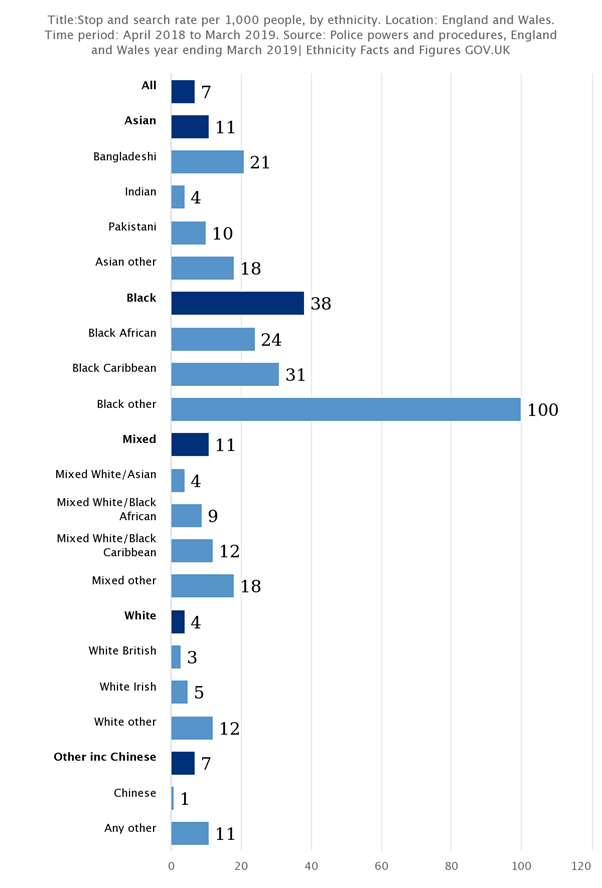
FACT. Between April 2018 and March 2019, there were 4 stop and searches for every 1,000 White people, compared with 38 for every 1,000 Black people in England and Wales. Now, I challenge anyone to say that’s not racism. Call it systematic, call it what you will, but it’s racism.

As human beings, it’s hard to process what figures really mean when it comes to life and death, so sometimes it’s best to look at a graph to visualise the problem. Take a look at the graph below and then tell me we don’t have a problem. It’s there for all to see and published on a government website under the ironic heading of crime, justice and law. Hmm, they might want to rethink that heading.

The stop and search rate for White people was lower than the national rate every year and the rates for the Asian, Black, and Mixed ethnic groups were higher than the national rate every year. Do you see a pattern emerging here? It’s a pattern that has repeated itself throughout history and it needs to stop.

This is just one example of how the powers that be within the justice system and those outside of it are abusing their powers in our society and on our streets, day in and day out. If that’s not everyone’s problem, I don’t know what is. We can’t just stand by and watch this power being abused while Black African, Black Caribbean and Other Black groups consistently have the highest stop and search rates.

During my studies, my legal career and through general life experience, my interest in systematic racism within the criminal justice system in particular has grown. That’s not to say it’s my only interest with regards to the BLM movement, it’s simply an area where I feel I can apply my legal mind to the matters at hand. Personally, I’ve spent a lot of time watching documentaries, films and series dealing with racial injustice and that was way before the newly released ‘Black Lives Matter Collection’ on Netflix. It is time well-spent and I urge you to take a look at this section of Netflix and learn something new, because you will. Your eyes will be opened. We can all do better, and this is just one way that we can try to educate ourselves.

But let’s remember, the UK has a serious problem too, there is no denying that. In fact, the world has a problem. It’s our problem because we all inhabit it, regardless of the borders, time zones or oceans that separate us. But the United States of America seems to be on another level, as the last few weeks have shown. The current resident of the White House certainly isn’t helping matters, in fact he’s a huge part of the problem. The hyper rich, white ‘elite’ who think that they can do whatever they please, as long as they write a big enough cheque.  Please come back Barack and Michelle!

In what world is it ok for anyone, let alone a police officer, to hold someone down and kneel on their neck while pinning them to the floor during an arrest? In our world apparently. This certainly isn’t conducive to the idea to serve and protect. Regardless of who they are and what they have done, this isn’t ok. We shouldn’t even have to ask ourselves this question, but here we are.

But what happens when they become a part of the system? According to Amnesty International, in a 1990 report, the non-partisan U.S. General Accounting Office found “a pattern of evidence indicating racial disparities in the charging, sentencing, and imposition of the death penalty.” The study concluded that a defendant was several times more likely to be sentenced to death if the murder victim was white. This has been confirmed by the findings of many other studies that, holding all other factors constant, the single most reliable predictor of whether someone will be sentenced to death is the race of the victim.

Disgusting. The colour of your skin should never increase or decrease your chances of death, ever. Nothing should. Neither should it increase your chances of finding yourself on trial, at the age of just 14, for the assault and rape of a white woman jogging through Central Park.

Wrongly convicted for the 1989 assault and rape of a female jogger in Central Park, these five black and Latino men — Kevin Richardson, Antron McCray, Raymond Santana, Korey Wise, and Yusef Salaam — served years in prison for a crime they didn’t commit. They were only released and exonerated of the crime because the real perpetrator decided to confess his sins after meeting Korey Wise in person. Big of him, huh? They became known as the “Central Park Five”- a name given to them by a very misinformed press. Again, a huge part of the problem. However, in the wise words of Oprah Winfrey, they should now be referred to as the “Exonerated Five” because their previous label was assigned to them before they were even (incorrectly) found guilty.

If you haven’t seen it already, watch “When They See Us” on Netflix. It’s a harrowing and gripping watch, but it made me want to be a better human being. I still can’t believe it really happened. Granted it was in 1989, but the behaviour of the police, the prosecutorial team, the press, and the judgemental public is all too familiar, and they should be ashamed of themselves for destroying five young lives. Their behaviour truly was criminal. Anyone who knowingly prosecutes an innocent 14, 15 or 16 year old child after beating him, depriving him of his rights and finally bullying a confession out of him isn’t only a part of the problem, they ARE the problem and it should be them standing up in court to answer for their crimes. This story really moved me and as history repeats itself with George Floyd, I wanted to use my skills to help in any way I can.

So, what can a legal translator do to help?

They can’t directly defend you in court, should you fall victim to the system. But what they can do is translate your documents for the relevant jurisdiction so that you have a fighting chance.

Let your voice be heard in English and let me communicate your messages for racial justice from French into English.

I would like to extend a discount to clients who want to fight for their rights in English. I want to help your voice be heard. Perhaps you have a vital report which needs to be released into the public domain in English or perhaps you have a social media campaign which needs to be heard by English speakers worldwide. It would be my privilege to help in any way that I can and translate the BLM movement from French into English.

While I will never be able to truly understand the struggle, I can ensure that I’m not part of the problem. As a legal translator, as a lawyer, as a small business owner and as a human being, I stand in solidarity with the Black community.

Money might be able to buy power and sometimes even justice, but it can’t buy your silence. Not where I’m concerned. Get in touch to make your voice heard. It would be my privilege, let me use it.

I would also love to hear your thoughts on what you are working on or blogging about and what content you would like to see in my blog. You can find me on all the usual types of social media or drop me an email at info@coleytranslates.com. I don’t bite, I promise!

Take care of yourselves and drop me a line if you fancy a chat.

Legally ginger,

Nicole

Featured

May the force (majeure) be with you. Is COVID-19 a force majeure?

Hola!

This blog post is really important and really relevant to anyone who has entered into any type of contract. So basically, everyone. We contract here, there, and everywhere these days, whether it’s signing on that dotted line for your dream home or clicking on the ‘buy’ button after an Internet shopping spree. These are just a few ways in which we contract with each other. Contracts really are everywhere and form part of our daily lives, but do you know your rights? If you have a contract which hasn’t been fulfilled because of COVID-19, then this blog post could be music to your ears. Go and dig out or CTRL and F a copy of the contract and see if a magical force majeure clause is included within in. Grab your favourite drink, get rid of any distractions, and prepare to be enlightened on force majeure. But we could be here a while, so get comfy.

COVID-19 is having a substantial economic impact on our world. Businesses need to consider the legal risks that arise and what they can do to protect themselves. The unprecedented measures of closing places of work and the disruption of production and supply chains, port closures, and suspension of air travel has caused widespread disruption throughout the world.

In such circumstances, force majeure claims may arise. However, whether the COVID-19 pandemic constitutes a force majeure event depends on the exact wording and scope of the force majeure provision in a contract.

I specialise in two legal jurisdictions: English and French law. That’s where I studied, trained and that’s where I have all my experience. If your contract is governed by English law, we will explore what this means for force majeure and we will also look at the role of force majeure under French law. These two jurisdictions provide for an interesting comparison as they are quite different, as you will. First up, it’s my first love…English law.

English Law

What is force majeure under English law?

Those linguists amongst you will have noticed that this doesn’t sound very English and you’d be correct. The words literally mean “superior force”. However, the words “force majeure” aren’t generally found in a contract governed by English law, as this is a civil law concept. The equivalent counterpart of frustration appears in contracts under common law.

Although the origin of force majeure is Roman, it was adopted by civil law countries and is most notably found today in the French Civil Code (the Napoleonic Code) dating back to 1804.

Let’s rewind for a minute. For those of you who don’t know, the English legal system is a common law system, whereas other jurisdictions such as France, Spain and Germany are civil law systems. That’s a blog post in itself, but it’s important to be aware of that distinction. Now let’s get back to today’s business.

Under common law (whether under English law or the law of another common law jurisdiction such as Australia), there is no doctrine of force majeure. Instead, the term is used to refer to contractual clauses which alter or relieve parties’ obligations and/or liabilities under a contract when an extraordinary event or circumstance beyond their control prevents one or all of them from fulfilling those obligations, such as natural disasters or war. Sound familiar? Did your ears just prick up?

A unique feature of common law contract law is that, subject to limited exceptions, the law leaves it up to the contracting parties to set out all the terms that will govern their contractual relationship in their contract. As such, it gives contracting parties the flexibility and freedom to decide the terms of their contract, and certainty that these terms will not be altered by legal principles existing outside of the contract itself. Let’s just hope you chose to include a force majeure clause before you signed on the dotted line.

If you included a force majeure clause in your contract, it may include events such as war, terrorism, earthquakes, hurricanes, acts of government, plagues, or epidemics. Where the term epidemic, or pandemic, has been used, that will clearly cover COVID-19.

An act of government will have occurred where a government body has imposed travel restrictions, quarantines, trade embargoes, or has closed buildings or borders. However, the position is less clear where the government makes recommendations rather than makes orders using legal powers. Most governments have made more than recommendations; I could have been fined or arrested for not complying with the quarantine restrictions here in Spain, and rightly so. An imposed quarantine such as that in the UK and in France should constitute an act of government.

But what happens if the term “epidemic” or “pandemic” isn’t explicitly referred to in the contract? That’s where the fun begins.

Where no relevant event is specifically mentioned, it is a question of interpretation of the clause whether the parties intended such an event to be covered. 

In unprecedented circumstances like the ones we are currently living in, the courts are likely to be generous in their interpretation of this sort of wording when faced with parties who have encountered genuine difficulties in performing. However, such parties will still need to show that their non-performance, or late performance, was truly outside their control and couldn’t have been prevented or mitigated.

Consequences of force majeure

Under English law, this freedom for drafting contracts means that depending on their drafting, such clauses may have a variety of consequences, including:

  • excusing the affected party from performing the contract in whole or in part;
  • excusing that party from delay in performance, entitling them to suspend or claim an extension of time for performance;
  • or giving that party a right to terminate.

This is in sharp contrast to contracts governed by French law. In France, force majeure is a general legal concept and courts may declare that a particular event, such as a global pandemic like COVID-19, is a force majeure event. But more on that later.

For this reason, it is common practice to include a force majeure clause in contracts, in order to relieve a party from performance of its contractual obligations where that performance is impacted by events outside its control. 

In general, an effective force majeure clause will be made up of two main parts: the definition of what constitutes a “force majeure event” and the operative provisions which deal with what happens if there is a force majeure event.

There is no general right to be able to claim force majeure in a common law jurisdiction. If force majeure is to apply, this must be explicitly included in the contract (including a definition of what constitutes a force majeure). If there is no force majeure clause and the business fails to deliver on time, the other party to the contract may be entitled to claim damages or perhaps even terminate the contract.

The effects of relying on the force majeure clause

The force majeure clause will also need to deal with what the parties intend to happen if it is accepted that an force majeure event has prevented a party from being able to perform its obligations. The usual remedy if a force majeure clause is invoked is for one or more of the parties to be excused from its obligations and/or liability under the contract, without any damages being payable. Force majeure clauses also sometimes provide for extension of time, suspension of time, or termination in the event of continued delay or non-performance. A right of termination could be commercially important, as it may provide leverage to renegotiate contractual terms.

Some clauses also expressly provide that additional costs incurred due to the inability to perform or perform on time will be borne by a particular party. If not, then it is likely that costs will be borne by the party that has incurred them, because there is no contractual provision to override this.

Prove it

If there is in fact an event which falls within the relevant definition of a force majeure event, the party seeking relief from performance will generally be required to show that:

  • it was prevented, hindered, or delayed from performing its contractual obligations as a result of the event;
  • the event/inability to perform was beyond its control; and
  • there were no reasonable steps the party could have taken to avoid the event or the consequences.

The term “prevent” has been interpreted to have quite a narrow meaning: the party claiming force majeure must show that performance of its obligations was legally or physically impossible, not just more expensive than what was originally anticipated.[1]

What if the force majeure isn’t with you because there is no force majeure clause in the contract?

Since force majeure is a creature of contract rather than a rule imposed by the common law, if there is no force majeure clause, an affected party will have to look to other provisions of the contract for potential courses of action. If the contract doesn’t provide any such courses for action, it may in certain circumstances be possible to rely on the doctrine of frustration of contract. It is extremely difficult to show that a contract has been frustrated so is it just you who is frustrated, or can you prove that your contract has been frustrated too?

The future of force majeure

COVID-19 is a timely reminder of the need to include force majeure clauses in contracts. I expect that from now on, contracts will make explicit reference to “national or global pandemics”, just as contracts were redrafted to include “volcanic eruption” after the eruptions of the Icelandic volcano which caused enormous disruption to air travel across western and northern Europe in April and May 2010. In the absence of the specific phrase of “national or global pandemics”, it is likely that “act of God” will include this unusual event. An act of God is an extraordinary event resulting from natural causes without human intervention and which couldn’t have been foreseen or guarded against. Depending on whether you believe the conspiracy theories or not, force majeure may or may not be included within this definition.

French Law

What is force majeure under French law?

Contractual force majeure is explicitly defined by French law, but this isn’t the case if the contract is governed by English law, as discussed above.

In most cases, contracts governed by French law won’t explicitly mention force majeure and therefore, it is necessary to refer to the texts and interpret them.

Force majeure is defined in Article 1218 (paragraph 1) of the French Civil code. This Article is applicable to contracts entered into after 1 October 2016. It provides the following:

Force majeure in contractual matters exists where an event beyond the control of the debtor, which could not have been reasonably foreseen at the time of the contract was entered into and whose effects cannot be avoided by appropriate measures, prevents the performance of its obligation by the debtor.

Article 1218 has taken over the previous case law criteria of unpredictability and irresistibility, abandoning the criterion of externality.

Any event which prevents a contracting party from performing its obligations may therefore be characterised as force majeure when satisfies the following three criteria:

  1. It was beyond the control of the party which can no longer perform its obligations.
  2. It was reasonably unforeseeable at the time the contract was entered into.
  3. It is irresistible during the performance of the contract. This irresistibility must make the performance of the contract impossible and not just more expensive or complicated.

The party seeking to invoke force majeure against the non-performing party must prove that these conditions are met.[2] 

Now where does COVID-19 fit into all of this?

  • French courts will consider whether the event can be attributed to that party, but a compulsory lockdown ordered by the local government would generally be deemed beyond the control of the party invoking force majeure.
  • As French courts proceed on a case-by-case basis, a similar event may be held to be unforeseeable in some circumstances but not in others. A recurring epidemic, such as dengue fever, within the same area, may not be considered to be unforeseeable. However, a one-off and (hopefully) nonrecurring COVID-19 pandemic hopefully will be held to be unforeseeable.
  •  The simple fact that an obligation has become more onerous or difficult to perform will generally not be sufficient to qualify as a force majeure event. If the outbreak of COVID-19 merely makes production more difficult or expensive, it would most likely not be considered an impediment preventing the performance of contractual obligations.

Consequences of force majeure

If force majeure is established, it would have the following consequences:

  • In the event of a temporary impediment, the performance of the contract will be suspended unless the delay resulting from such suspension justifies the termination of the contract.
  • In the event of a definitive impediment, the contract will be terminated by operation of law and the parties released from their obligations pursuant to Article 1351 of the French Civil Code.

Article 1351 of the French Civil Code provides that “the inability to perform the service shall release the debtor accordingly where it is due to a force majeure event and is definitive, unless the debtor has agreed to perform the service or has been given prior formal notice”.

In other words, the party referring to the force majeure event will be released from its obligations and cannot be held liable for its contractual breach.

What if the force majeure isn’t with you because it doesn’t apply?

Perhaps Article 1195 of the French Civil Code could help you out. Hardship applies in any contractual relationship governed by French law entered into since the 1 October 2016 law. This provides for the possibility of renegotiating a contract in the event of “a change in circumstances unforeseeable at the time of entry into the contract which makes performance excessively onerous for a party who had not agreed to assume the risk.”

The term “unforeseeable” is used only if performance of the obligation hasn’t been made impossible, but only more difficult by the debtor, either because it will in return obtain only a performance whose value will have been considerably reduced, or because performance, while not impossible, will require greater effort and a longer period of time than initially envisaged.

If COVID-19 is considered “unforeseeable” and if the application of the above-mentioned provision isn’t excluded (which is contractually possible), the parties could always try to rely upon this provision as an alternative to force majeure, in order to try to renegotiate the existing contract.

So, is COVID-19 a force majeure?

Now that’s why you are all here. It really is the million dollar question. And, as a true lawyer at heart and as you can see from the legal analysis above, I’m going to leave you hanging with “it depends”.

Under English law, given the almost unprecedented nature of the COVID-19 outbreak and/or the actions of governments worldwide in response, it is likely that COVID-19 would constitute a force majeure event under many force majeure clauses. However, whether the COVID-19 pandemic constitutes a force majeure event depends on the exact wording and scope of the force majeure provision in a contract or in fact, the very existence of such a clause.

Nevertheless, just because a force majeure event has occurred doesn’t necessarily mean that the parties will be protected from liability for failing to perform or a delay in performance.

Under French law, force majeure is becoming more probable every day considering the rapidly evolving governmental decisions and the already available case law.

As force majeure provisions are not public policy provisions, the definition or the effects of force majeure may be subject to contractual arrangements, including a broader definition of force majeure.

These are some considerations to be considered when reviewing a force majeure provision:

  • If the force majeure clause expressly specifies epidemics, diseases, and/or public health emergencies as qualifying force majeure events, it is likely that the COVID-19 pandemic would qualify.
  • Even if epidemics, diseases, and public health emergencies aren’t expressly specified as being force majeure events in the contract, COVID-19 may nevertheless fall within the general force majeure wording as an unforeseeable event beyond the parties’ reasonable control.
  • If the force majeure provision defines “acts of government” as being force majeure events, it can also be argued that government-imposed travel bans and restrictions, city lockdowns, and mandatory business closures constitute “acts of government” beyond the parties’ reasonable control that prevent the performance of contractual obligations.
  • The party seeking to invoke force majeure will typically need to show a causal link between the force majeure event and the failure to perform contractual obligations, and the party must prove that COVID-19 has made it actually impossible for it to perform its contractual duties. It is unlikely that a party will be able to rely on force majeure simply because performing its contractual obligations has now become more expensive, onerous, or time-consuming due to COVID-19. For example, a party seeking to rely on force majeure may need to show that it was impossible for it to source for alternative suppliers, contractors, materials, or personnel.
  • The existence of a pandemic or an epidemic is not always sufficient to constitute force majeure. French case law has ruled out this qualification for force majeure on several occasions:
  • Plague (CA Paris, 25 September 1998, no. 1996/08159)
  • Dengue Fever (CA Saint-Denis de la Réunion, 29 December 2009, no. 08/02114; CA Nancy, 22 November 2010, no. 09/00003)
  • SARS (CA Paris, 29 June 2006, no. 04/09052)
  • Chikungunya (CA Basse-Terre, 17 December 2018, no. 17/00739)
  • H1N1 (CA Besançon, 8 January 2014, no. 12/02291)
  • Ebola (CA Paris, 17 March 2016, no. 15/04263; CA Paris, 29 March 2016, no. 15/05607)

However, the pure scale of government measures in response to COVID-19 is exceptional and extraordinary in nature and is broader in scope than previous pandemics. The World Health Organization (WHO) has declared COVID-19 a public health emergency of international concern. This is only the sixth such declaration by WHO and supports the view that COVID-19 is an unprecedented event.

  • Parties should also consider how long the contractual obligations will be suspended as a result of force majeure. Given the fluidity of the situation, it may be difficult to ascertain when an event of force majeure has commenced, and when it has ended.
  • It should also be noted that on 12 March 2020 the Court of Appeal of Colmar ruled that COVID-19 is a force majeure event in the context of an administrative incident. However, nothing legally prohibits the application of the same rules to contractual obligations.[3] 

While this may be the first decision of its kind on this issue in France, there is still a lot up for debate! It has been determined that COVID-19 should be treated as a force majeure in the context of French public procurement contracts, which protects companies with public procurement contracts from being penalised in the event of late performance. But what does this mean for B2B or B2C agreements?

The determination of the existence of a case of force majeure in contractual relations between businesses or with consumers is still up for debate and it’s a matter to be determined at the sole discretion of the French courts.

The judge will determine whether the coronavirus pandemic constitutes a force majeure event on the basis of the facts of each case, and in particular with regard to the possibility of implementing appropriate measures to avoid adverse effects on the performance of the contract (for example, use of alternative sources of supply, production at other sites etc).

Of course, this is only if the parties don’t fight it out amongst themselves (across a table) first.

Future of force majeure

Companies may draft their force majeure clauses more broadly in the future to clearly include pandemics and public health emergencies, without the need to rely on a force majeure certification. In some countries, such as China, government authorities will sometimes issue companies with “force majeure certificates” in cases where there is an event which has a broad impact (for example, the COVID-19 outbreak of 2020). In a common law jurisdiction such as English contract law, such a certificate may be useful evidence of the fact that a force majeure event has taken place, but it is unlikely that the existence of the certificate will be sufficient to invoke the application of the force majeure clause. Unless, the clause expressly refers to the issue of such a certificate as being a trigger.

How can I help you?

Any party wishing to rely upon force majeure must review relevant contracts immediately and seek legal advice from a qualified professional. Often clauses have provisions requiring immediate notification and a failure to comply with these can render a subsequent force majeure argument redundant.

I think we have established that force majeure is going to create a lot of work for French and English contract lawyers and legal translators too. This is where I come in.

As a legal translator with a qualifying English and French law degree, I am qualified to translate French contracts and documents into English. If you need my help with legal translation from French into English in this field, please don’t hesitate to contact me at info@coleytranslates.com.

I’ve already been able to help a number of clients in this field by translating their contracts for them at this very stressful time. Working on these projects on a regular basis since the COVID-19 outbreak guarantees that I understand the recent legal developments in this field. Rest assured that my current understanding of force majeure in English and French law allows me to make informed translation choices for you.

Alternatively, if you require any legal advice with regards to force majeure, please contact a qualified legal professional with respect to any particular issue or problem.

I would also love to hear your thoughts on what you are working on or blogging about and what content you would like to see in my blog. You can find me on all the usual types of social media or drop me an email at info@coleytranslates.com. I don’t bite, I promise!

Take care of yourselves and drop me a line if you fancy a chat.

Legally ginger,

Nicole

Disclaimer: This information is for informational purposes only and not for the purpose of providing legal advice.


[1] Tennants (Lancashire) Ltd v G.S. Wilson & Co. Ltd [1917] AC 495

[2] (Com., 17 March 1998, no. 95-21.547 D, RJDA 7/98 no. 753). See also CA Paris, 17 March 2016, no. 15/04263)

Featured

From hot desking to getting hot at your desk: do try this at home!

Hola! 

It seems that when I switched from face-to-face to online personal training sessions when I moved to Spain, I was in fact setting myself up well for weeks and weeks in lockdown. Little did I know how it would really benefit me when I was confined to my little flat in the heart of Barcelona, unable to stretch my legs for weeks on end. 

Online personal training is accessible for anyone with an Internet connection. It really is that simple. For people who claim that they don’t have the time to exercise or go to the gym, or they simply don’t enjoy the gym environment, this is the perfect solution for you. Believe me, I was one of those people, but I’m a changed woman now. We provide tailored translation services for our clients and online PT does the same for me, in the comfort of my own home. Often the workouts that I do require little or no equipment and even though I’m now at an advanced stage of my training, that doesn’t mean that I need my own state of the art gym in my home, but if you have the space for it then who am I to stop you? A gym is definitely on the cards when I move into my dream home. But for now, I’m coping just fine with a few sets of different weighted dumbbells, a kettlebell, an ab roller, a resistance band, and a standard exercise mat. Nothing fancy, but I have a completely new body shape and the abs (I wish) to show for it. However, before I introduce you to my wonderful PT and friend back in the UK, I want to go back to the beginning of my journey and explain why I enlisted the help of a PT in the first place. 

It’s exactly a year since I decided that, after sitting at a desk day in and day out since September 2018 while I was getting my business off the ground, it hadn’t done my mental or physical health any good. I wasn’t moving enough, my Fitbit constantly reminded me of that fact and while I may have gone to bed mentally exhausted after working with words all day, I was rarely physically exhausted. This wasn’t helping my sleep quality much either and whoever said “sleep is for the weak” didn’t run their own business. We need sleep and running a business certainly requires a respectable amount of sleep every night. I had this sudden urge to move around and stretch my body on a daily basis, just as much as I stretched my mind. After finishing my Masters in Translation Studies at Durham University in September 2018, my body was no longer a temple. The student lifestyle isn’t conducive to a six pack or peak physical fitness. I went into the university year feeling great after completing my first half marathon and loving every minute of it. I came out of the year unable to run another one and wanting to get back into shape. After taking six months out to start my business (the best thing I ever did), April 2019 was where my love for keeping fit really began. 

Meet Jennie-Marie Glover, my PT and one of my biggest cheerleaders. She believed in me before I even believed in my own fitness journey, do you know how rare a quality that is to find in a person these days? I knew she was the right PT for me when she hugged me goodbye after our first taster session. Yes, hugging is that thing that some of us used to love doing before social distancing arrived. Fast forward seven months and I decided to move to Spain and Jennie came with me via FaceTime. 

As translators, we are often chained to our desks and if we are freelance and work from home, we are dangerously close to the kitchen. This is more of an opportunity than a threat though because you have the opportunity to eat exactly what you want…you just need to make the right choices. You won’t be falling into the trap of those office workers who need a McDonalds, or a bacon butty run to get them through a Friday. Or will you? Unless you live in Windsor Castle with Lizzie and have 52 bedrooms and 92 offices, your walk to the fridge or the bathroom just isn’t enough to keep you fit and healthy. This is where online PT comes into its own. You just need to take a few steps from your desk to your mat and your fitness journey can begin. Now how is that for a commute? A very worthwhile one, let me tell you.

I have seen so many benefits to my training; yes, there are the physical benefits, but for the purposes of this blog post, I’m interested in what this training has done for my business specifically, as I’m sure you are. There is so much science behind the benefits of exercise and let me tell you, it’s all true. If you are a morning person, you can work out before you start your day, if you are a night owl you can work out after work. Or if you want to mix it up and sometimes work out at lunchtime (yes freelancers should have those too), the possibilities of ‘when’ really are endless. We are often told that for some of the most successful people in business, rising early is key to their success. However, our office is a lot closer to home, so we don’t need to set our alarm for the crack of dawn. Just because the Apple CEO starts his mornings at 3:45 am and the Oprah Winfreys and Michelle Obamas of the world have been known to rise at the crack of dawn, doesn’t mean that you have to. The whole point of online PT is that it’s on YOUR terms, it’s your home after all.

Now let’s get to the juicy bit, the benefits to my business and to yours. When we think about the value of exercise, we tend to focus on the physical benefits but over the past decade, social scientists have gathered compelling evidence suggesting that there is another, more immediate benefit of regular exercise: its impact on the way we think. According to the Harvard Business Review, and let’s be honest those guys really know their stuff, studies indicate that our mental firepower is directly linked to our physical regimen. And nowhere are the implications more relevant than to our performance at work. Consider the following cognitive benefits, all of which you can expect as a result of incorporating regular exercise into your routine:

  • Improved concentration
  • Sharper memory
  • Faster learning
  • Prolonged mental stamina
  • Enhanced creativity
  • Lower stress

This sounds like a recipe for success for any freelance translator to me, or any small biz owner for that matter. Exercise has also been shown to improve your mood, which has serious implications for your performance in your home office. Building business relationships and fostering collaborations is fundamental to what you do, so if you are in a better mood, this will really help you to connect with your clients more and directly influence your success. That all important conference call for an exciting new project will go swimmingly, and you will be as cool as a cucumber when your client needs you to turn a tricky legal project around within 24 hours. Challenge accepted!

There is also evidence suggesting that exercise during regular work hours may boost performance. Have you ever been envious of those people who have access to free weights or a yoga studio at the office? Don’t be envious because you can be one of those people. You are living the dream…once an online retailer has delivered your limited equipment right to your doorstep.

Something I read recently on the Harvard Business Review is that “instead of viewing exercise as something we do for ourselves—a personal indulgence that takes us away from our work—it’s time we started considering physical activity as part of the work itself”. Preach! I couldn’t have put it better myself. The alternative of processing information more slowly, forgetting more often, and getting easily frustrated are certainly not conducive to a successful business model.

There is no right or wrong way of incorporating exercise into your routine…that’s the whole point. It has to be right for YOU. It’s your body and your business, but if you incorporate exercise into your working day, it makes it a lot easier to make time for it. Therefore, that old chestnut of “I don’t have enough time” no longer works. Remember, this is time away from your desk so that you can invest in yourself and your business. If you aren’t well, neither is your business, as you are your business. Just imagine the added value to your business; a sharper, faster, more creative translation machine, otherwise known as you.

I train three times a week with my PT, but I’m kind of addicted to the #indoorphins and the overall feeling of being a hot, sweaty mess, so I exercise most days in quarantine. The beach is just 7 minutes away, so I need to make sure that my beach bod is literally ready to go once I’m released from captivity. Sometimes I train in the morning and my PT kickstarts my day…literally. I then sit down at my desk (ouch) with my first cup of tea of the day with a renewed perspective and raring to go. Other times, at the end of the day, I shake it off by getting up from my desk creaking and groaning (yes, even though I do have an ergonomic chair) and working out the day’s frustrations through a few burpees or 100 (ouch).

First and foremost, and before you go any further, you must read this disclaimer. I’m a legal word nerd and a lawyer at heart, so you didn’t think I would just dive right into it, did you?

You must ensure that you warm up and warm down properly before and after this workout as those muscles needs to be stretched out before AND after you attempt this workout. You must also ensure that you seek professional medical advice if you have any existing medical conditions, coronavirus or if you have simply never exercised before. This video is not an invitation to get off your sofa and injure yourself so please read the legal disclaimer below before you carry on reading and watching.

Legal Disclaimer

The information contained in my blog (www.legallyginger.law.blog) and through Jennie-Marie Glover’s website (www.jennie-marie.website) is for educational and informational purposes only, and is made available to you as self-help tools for your own use.

Nicole Fenwick and Jennie-Marie Glover (“we”) strongly recommend that you consult with your doctor before beginning any exercise programme. You should be in good physical condition and be able to participate in the exercise.

We are not a licensed medical care provider and represent that we have no expertise in diagnosing, examining, or treating medical conditions of any kind, or in determining the effect of any specific exercise on a medical condition. You should understand that when participating in any exercise or exercise programme, there is the possibility of physical injury.

If you engage in this exercise or exercise programme, you agree that you do so at your own risk, are voluntarily participating in these activities, assume all risk of injury to yourself, and agree to release and discharge Nicole Fenwick and Jennie-Marie Glover from any and all claims or causes of action, known or unknown, arising out of this blog post.

Now I’m going to pass you to Jennie, you are in safe hands I promise.

You can do three rounds of the following workout- 30 seconds work and 30 seconds rest, or you can push yourself and do 45 seconds work and 15 seconds rest for each exercise. If you are feeling adventurous because you are at an advanced level, you can do each individual exercise for 1 minute with as much rest as needed or you can choose to do 10/12/15 reps of each exercise.

  • Squats- – These target the glutes and quads.
  • Bulgarian split squats- These target the glutes and quads.
  • Press ups- – These target the chest, back and triceps.
  • Leg raises- These target the glutes.
  • Leg raises to the side- These target the abductor and glutes.
  • Side touches/Russian twists- These target the obliques.

If you fancy some HIIT, you could try:

  • 10 squats
  • 10 press ups
  • 10 burpees
  • 10 lunges
  • 10 crunches

However, you won’t see me demonstrating the HIIT workout on the video because quite frankly, no one wants to see that.

If you fancy a snack after breaking a sweat over something other than a temperamental CAT tool, why not try one of the following:

  • Almonds
  • Mixed seeds and nuts
  • High protein yoghurt
  • Green apples and grapes
  • Berries
  • Chopped vegetables such as carrots, celery and peppers
  • Cherry tomatoes

I think we can all agree that these are way healthier than your secret quarantine stash. Drinking lots of water is also a great way to flush out toxins and supports tissue repair, focus and helps to flush fat out.

Now here is the fun part. Here is a video of me doing a chair workout. As you can see, I have an ergonomic chair. This is particularly important and is worthy of its own blog post. I’m also using some dumbbells, but I know that not everyone will have these to hand at the moment so use whatever you can get your hands on. Those of you in the UK can reach for the trusty tins of baked beans, whereas others can use tins, bags of rice or potatoes, 8 litre water bottles etc. I know that I’m not the only one who has got creative with their makeshift weights, as I spoke to a fellow translator who was hoping to source some sand to supplement her exercise regime. Get creative!

Overall, start small and steady and do not try running a marathon at home. I have been using the Pomodoro technique recently and so perhaps, a good way to ease yourself in might be to use the Pomodoro technique’s 15 minute rest rest/reward to stretch those legs by treating yourself to the toilet on a different floor or purposefully drink water by the glass so that you have to move to get a refill.

So, there we have it. Some great advice from someone other than me to mix it up a bit and you get to see a legal translator sweat over something other than rendering a French contract or a perplexing trademark application into coherent English. Priceless!

And just in case you still need another reason to stay fit and healthy, the healthier and fitter you are, the better the chance you have of fighting off the nasty coronavirus virus. Exercise is a no-brainer now, right?

Don’t let a thing like isolation keep you from being fit and healthy, neither your body nor your business will thank you. I would love to hear what you think to this workout or even better, share your selfies or a video of you doing the workout. It’s not a competition, just a way that we can all hold each other accountable, regardless of where we are in the world. Plus, we could all do with a good laugh!

If you want to pick Jennie’s brain about anything, please visit her website and get in touch with her. She is also from Yorkshire, so she also has that friendly Yorkshire charm and is always willing to help.

I would also love to hear your thoughts on what you are working on or blogging about and what content you would like to see in my blog. You can find me on all the usual types of social media or drop me an email at info@coleytranslates.com. I don’t bite, I promise!

Take care of yourselves and drop me a line if you fancy a chat.

Legally ginger,

Nicole

Featured

Isolation doesn’t have to be isolating

Hola!

I know what you are thinking…now there’s an oxymoron! Bear with me, there’s method in the madness. I’ve had more social contact with friends and family in the first few weeks of lockdown than I’ve in a long time. Just not IRL. I’m not sure what that says about my social life though. 

Instead of learning about what is going on in the world from the news, I’ve opted for a more personal approach and decided to place more trust in the news from my friends. It’s more important to stay in touch with loved ones and get an idea of the situation on the ground straight from the horse’s mouth. Instead of just listening to Chinese whispers on social media. I don’t know about you but chatting to a friend on the other side of the world is way less depressing than watching the news. It should also give you a good sense of what’s really going on. If you find this more depressing than the news then you definitely need to find new friends. 

I’ve chosen to distance myself from the constant news cycles; I owe it to my mental health. It’s strangely ironic that at times like this, I don’t want to know exactly what’s going on. The figures won’t help me sleep at night. However, I feel it’s important to assess whether this is conducive to your own mental health. This is a very personal decision. If knowing every detail about the pandemic gives you peace and gives you a sense of control over the situation, you do your thing. That’s just not my jam right now. 

I’m in a love/hate relationship with social media while in lockdown. It is both a blessing and a curse. My professional social media profiles have allowed me to connect with other translators far and wide and have often allowed me to maintain some form of normality. Sometimes we talk about translation and sometimes we just put the world to rights or share funny memes. However, there is some rogue information out there at the moment that has to be taken with a bucket of salt. Did anyone hear about the cute dolphins in the turquoise waters of the Venetian canals (aww)? Amongst all the chaos, this is just what I needed to hear. Well get your facts right because according to National Geographic, these dolphins were miles away from Venice. I love dolphins and a dolphin appearance in Venice would be weirdly poetic right now but sadly, it’s just not meant to be. 

My advice to you at the moment is to enjoy social media and use it for the greater good, but don’t go all Donald Duck on us and spread fake news because it seems that social media is already giving his big, bad rep a run for its money and that’s saying something. Spread love. 

After contemplating what a week in lockdown should look like, I decided to look at a map of the world and see how many countries I had virtually visited in the last week. I’ve contacted friends and colleagues in Belgium, China, Croatia, France, Germany, India, Ireland, Italy, Mexico, Panama, Spain, Thailand and the UK. It seems like I’m spreading almost as fast as coronavirus (too soon?). I’m really trying to find a silver lining to this situation and so your challenge, if you choose to accept it, is to see how many colleagues and friends you can connect with over the next week. Yes, it’s another week of lockdown (unless you are just chilling on the beach like some thoughtful individuals), but it’s also an opportunity. Remember the good, old SWOT analysis analogy I used in my previous blog post; well this is another situation where the opportunity presented by the pandemic can be fully enjoyed. All those people you’ve been meaning to catch up with for months….there really is no time like the present…or the next few weeks or months (eek) for that matter. I’m in a serious relationship with travel and having friends all over the world is just another excuse that I don’t need to feed my addition. However, we are on a break right now. Luckily, I visit France virtually four days a week to teach legal English to French lawyers and support their learning and well-being. Get in touch and let me know how many countries you are virtually visiting these days. You never know, you might just make someone’s day.

Human behaviour is a fascinating phenomenon. My Netflix history is testament to this given the amount of true crime documentaries I watch. Not sure if that says more about me or the criminals?! This pandemic is fundamentally changing the way we behave and the way we communicate, and I think these changes can be perceived both positively and negatively. My behaviour has in fact changed for the better. I started writing this blog post on a Saturday evening, which isn’t my average Saturday night but a very enjoyable and relaxing evening all the same. I’ve even changed some of the ways in which I do business. Don’t get me wrong, I still rock up to my desk every morning, but the time depends on how much sleep I’ve had. But as always, I spend most of the day at my desk, I just don’t leave the flat for fresh milk or fresh air. My asthma has put an end to that pipe dream.

It’s also changing the way we socialise. Did you think that after work drinks were a thing of the past? Fear not, people are embracing apps such as House Party and Zoom to host such events or carry on the local pub quiz. Other apps are available, and you should always read the privacy policy of any app or platform you use. I recently had a video call with ten Durham University friends in six different countries using Amazon Chime…this was a helpful suggestion from one of the aforementioned friends who is a Vendor Manager at Amazon’s Munich office. This week I also tried out Google Hangouts for the first time to chat to another Durham University friend who works at Google’s European Headquarters in Dublin. It’s not what you know, it’s who you know!

Surprisingly, this whole situation hasn’t changed the way that I exercise, apart from the obvious not stepping outside my flat door in 27 days. It seems that I was ahead of the curve on this one, for once in my life. When I made the move to Spain from the UK back in November last year, I brought my Personal Trainer with me. Virtually of course! As fit as she is, she didn’t in fact comply with Ryanair’s new hand luggage requirements. Since arriving in Spain, I’ve been training via video call which has worked like a dream. It requires minimal equipment (1 exercise mat, 1 kettlebell, 2 dumbbells, 1 ab roller, 1 resistance band and a lot of blood, sweat and tears) and all I’ve to do is turn up in front of my iPhone/iPad screen three times a week. I always look forward to my classes but at the moment, they give me that boost of endorphins that we are all craving. Give it a go! If you don’t believe me, check out my next blog post featuring my PT Jennie-Marie Glover as a guest blogger. She has even prepared a workout video for you to try at home and all you need is your office chair. It better be ergonomic though as she told me off for this one! You know you want to! And you really have no excuse.

One thing which hasn’t changed amongst all the chaos in the world recently is where I work. I’m still translating and teaching from the very same desk. Although just before the world changed beyond recognition, I had found a lovely little coworking office in Barcelona where I hope to work from one or two days a week once this is all over. I do enjoy socialising more than social distancing. Contrary to popular opinion that translators are all introverts, and this is just business as usual for us as we are used to it anyway…this isn’t business as usual for anyone, it’s business as best we can. The place where I work may not have changed but the way I work and how I work has changed to a certain extent. I’m dedicated to making sure I can serve my clients in the best way possible during this period and if that means bending over backwards and offering extra support, I wouldn’t have it any other way.

One thing which has been a saving grace amongst all the chaos has been another aspect of my business: teaching. Especially when you are already used to teaching remotely. It seems like I was ahead of the curve on this too. Teaching legal English classes to lawyers and notaires all over France and French to students all over Europe all from the comfort of my home office really has been a blessing. My students have played a huge role in keeping me sane. It’s surprising how discussing the intricacies of French property law or the rules of intestacy under English Law can really help to brighten your day and the amount of brain power it requires certainly doesn’t allow time for dwelling on the current situation. Teaching has always been an outlet for me, although I only really ‘fell into it’ during my postgraduate studies at Durham University. It took off so much that my friends often used to check that I was still with the land of the living, as sometimes they wouldn’t see me for days at a time…which is a big deal when you go to a collegiate university and you live and breathe your college life with your college family. Then, my students were a fantastic way of ensuring that my French language skills were contemporary and sharp enough for one of the best Masters in Translation courses in the country, while also distracting me from other things that were going on in my life. Now, they are doing exactly the same for my business and my life in general! All students are great projects to work on, or maybe I’m just very lucky with my particular students. Teaching has been a fantastic addition to my business from a social point of view as it helps you maintain regular, social contact when freelancing. Anyone who knows me, knows that I don’t require any encouragement when it comes to socialising, but this can be a really useful tool for freelancers who want to brush up on their language skills and also increase their contact with the outside world. Stepping outside the freelancing bubble is always very important but now more than ever before. Look on the bright side, masks and proper office attire aren’t required over Skype. As you can see, teaching French and legal English has taught me a lot. So much in fact that I will dedicate a whole blog post to the teaching services I offer within my business. If you are a French lawyer or notaire and you are interested in perfecting your legal English skills for your English-speaking clients, look out for that blog post or just get in touch with Languages for Lawyers. It’s business as usual for us, wherever you are.

Last but certainly not least, sleep! I’m in a serious relationship with sleep, but our status is currently “it’s complicated”. My sleep just isn’t the same and this is due to a number of factors. Lack of fresh air, lack of exercise (my daily constitutional and outdoor activities), waaay too much screen time and general anxiety. Has anyone else been experiencing very bizarre and vivid dreams? Try to get as much sleep as you can but indulge in siestas at your own risk as they really are a double-edged sword. If you want to explore sleep more deeply, have a listen to the latest episode from Smart Habits for Translators on Smart Sleep Habits. I also get a mention at the beginning of this episode which was a lovely surprise. This podcast held me accountable when I listened to it because it reminded me that bedtime routine doesn’t just apply to your evening routine. This also applies to your morning routine. Freelancing lends itself well to being both an early bird and a night owl. I’m most definitely the latter but try not to sleep in too much because I tried this accidentally in the second week of lockdown when this whole experience started taking its toll on my sleep and it didn’t end well. It made me crave siestas way too much.

I would love to hear about what you’ve been doing to avoid feeling isolated in isolation. I would also love to hear your thoughts on what you are working on or blogging about and what content you would like to see in my blog. You can find me on all the usual types of social media or drop me an email at info@coleytranslates.com. I don’t bite, I promise! Take care of yourselves and drop me a line if you fancy a chat.

Legally ginger,

Nicole

Oh, my Gaudi, I thought Corona was something you drank with lime

Hola!

Spain is now the worst-hit country in Europe after Italy and boy, does the media keep reminding us of that. Has anyone considered a news ban for your own sanity? So, Catalonia is now on lockdown and as of 8am today, we are only allowed out of our homes for emergencies, to buy food, or for work. However, these are things that I can’t change so let’s try and look on the “bright” side of this situation, or at least find a slightly less dull side. This “bright” side doesn’t mean that we will automatically come out of this smelling of roses, but it means that we will remain safe and sane throughout.

People never cease to amaze me! So many people have reached out to me regarding the lockdown. Friends, colleagues and people I have never even spoken to before. Just in case you need a friendly reminder, here it is: we will get through this…together! Whether we are in rural Italy singing our hearts out, or on a flat balcony on the edge of the gothic quarter in Barcelona applauding all the medical professionals fighting to beat this, we are all under the same sky.

I’m trying to remember that throughout all of this, it is important to be thankful for what we do have and not what we don’t. So today I am choosing to be thankful and grateful. Thankful that all the people I love are staying safe wherever they are in the world and grateful that as a freelance translator, I have not had my working life rudely interrupted by coronavirus, as I work from home anyway. As translators, we can adapt easily and although, we are (incorrectly) stereotyped for being introverts and social recluses, quarantine isn’t as much as a shock to our system as it is for some professions. That being said, choosing to socially distance ourselves or limit our social interaction with the outside world is one thing, but having a quarantine imposed on us so we can only leave our own home in certain circumstances is a very different story. That no longer becomes a choice and instead, becomes a necessity. A very candid newsletter that I subscribe to landed in my inbox last week and boy am I glad it did. It made me feel like I wasn’t alone in this (even though I know I’m not) and being truthful, it was one of the reasons I decided to write this post, so thank you to my fellow translator and neighbour here in Barcelona, Maéva Cifuentes for her comforting words. In her words, “us translators have been practicing self-quarantine for years. We’re pros! Let’s use those skills”. Subscribe to her newsletter here if you fancy some fresh reading material for the coming weeks.

Coronavirus is the trending topic in so many countries but I’m not writing this to be trendy or to boost my blog views, I’m writing this post because I feel like I need to write and keep in touch with the outside world. Before coronavirus turned our lives upside down, I had been journaling every night before I went to bed and I had been finding it very cathartic; it’s helped the quality of my sleep no end so maybe it can help me when I’m awake too. I’m not going to give any advice or pretend to be an expert in anything; instead I’m going to share some thoughts and ideas from a freelance legal translator who has found themselves under house arrest in a foreign land.

On Friday, my parents asked me to fly back to the UK because I have mild asthma and they want me to be at “home” in case I contract coronavirus and require the services of the NHS. My parents are not hypochondriacs, my Mum is a nurse, so she knows her stuff but first and foremost, she is a Mum and you do anything to protect your children, right? They are my parents, it’s only natural that they would want me to come home. But where is home? I thought about going “home”, but I chose to make Spain my home in November and unlike the UK, I don’t just abandon ship (the EU) when the going gets tough, so I am staying put. I made the decision to stay in Spain and not buy a €300 one-way ticket back to the UK (cheers Ryanair). This was just before the decision was taken out of my hands anyway and the Spanish government declared a state of national emergency and put us on lockdown.

I am sat in my flat on the first day of this unprecedented set of events and wondering how I will fill the days, weeks or maybe even months ahead of me. Of course, I plan to werk, werk, werk (I hope) and maybe save some more money thanks to the new corona ISA. We now also have a swear jar in our flat- the swear word being the new dreaded “C” word, anything news-related or just generally depressing. Each misdemeanour will result in a €1 donation to the jar which will be used to fund a holiday when coronavirus is a far, distant memory.

I have so many non-urgent things on my work to-do list that keep being moved down the list from one month to the next. Maybe now those things will finally see the light of day or maybe now it’s time for those books in my reading list to be dusted off? As someone who likes to keep busy, I’m hyperactive and I’m an over-thinker with a pet hate for laziness, so quarantine and I aren’t a match made in heaven. However, when life gives you coronavirus, build your business. I am sure that most of you are familiar with SWOT (Strengths, Weaknesses, Opportunities and Threats) analysis and I am choosing to focus on the O in this situation. So, what opportunities can coronavirus present to a translator? Indulge me for a moment, I haven’t lost my marbles just yet.

Health

This is our priority at the moment and in reality, it should always be our priority. If a global pandemic doesn’t remind you of that, then no blog is going to help you. Simples!

I am determined to continue eating my 15 pieces of fruit and veg a day. A great tip from my Personal Trainer is to swap fresh fruit and veg for tinned or frozen versions so that you can buy more, and they will last longer if you need to self-quarantine. This way you get all the goodness at a fraction of the price and you can access all the nutrients from the comfort of your very own sofa or desk…whichever place you have chosen to spend the coming weeks.

Normally, I have Skype PT (personal training) sessions three times a week, but I plan on increasing this while I’m on lockdown to ensure that:

  1. I don’t go crazy.
  2. I don’t become a couch potato.
  3. I maintain my bikini body for the quarantine-free summer (please hurry up).

In an ideal world (what’s that?!), I will start/end every day with either yoga or some form of physical exercise to keep me healthy both physically and mentally. It will also help me sleep when I essentially sit at my desk all day. Don’t neglect your mental health- this whole situation could really take its toll mentally as well as physically, so please reach out if you need anything. Like I said, I don’t profess to be an expert on this situation, but I’m always here for a chat regardless and I promise to always give you the best and the kindest advice that I can. I have made sure that I have reached out to as many friends and colleagues as possible across Europe and the world, to check in with them and their family. Coronavirus has not infected the Internet so make use of it. Use Facetime, WhatsApp and Instagram to your heart’s content.

Human contact

The idea of health and using Facetime, WhatsApp and Instagram to your heart’s content leads me onto the next important opportunity that is available to us: human contact. Granted, this won’t be IRL but considering people get married after meeting on dating apps, it’s not beyond the realm of possibilities that perhaps the odd voice note, or video call will bring a smile to someone’s face. Someone has already offered to have a virtual coworking session with me even though we are in the same city (muchas gracias Maéva) and I already have a few Skype dates in the diary. One of which is particularly important as it’s a friend who is now in the fourth week of quarantine in Bologna and I think she needs to see a friendly face. She is supposed to be visiting me here in Barcelona in a month’s time but that is looking unlikely and may also have to be a virtual visit. Reach out to friends and colleagues who are in quarantine and those who aren’t. Just reach out! If you think that hearing the dulcet tones of a broad Yorkshire lass might help cheer you up, please reach out for a chat. I won’t blame you if you don’t want to as it’s not the nicest accent in the world but us Yorkshire folk are renowned for our friendliness, so all jokes aside, I’m here for you anytime.

CPD

Webinars are a great way to learn and they can be done from the (dis)comfort of lockdown. Webinars are also handy because you can often register for them and then watch them at a convenient time for you, so if you don’t even have to watch them live…you have no excuse! They shouldn’t be affected, and they are usually free, so see what’s out there and get a few booked in your diary.

A lot of translation conferences have been affected by the pandemic but instead of being cancelled, some conferences are going online. I really wanted to attend the BP20 Translation Conference this year in Nuremberg, but I couldn’t make it in person. It is now going to take place online and so I might be able to go after all. Life is weirdly ironic at times!

Reading

Reading is really important for translators and it’s always helpful to do as much reading as you can in your area of specialism. However, that’s easier said than done between the thousands of words a day that you are supposed to be translating, the millions of emails you are expected to reply to and all the other tasks we have to do on a day-to-day basis to keep our businesses going.

Read as much as you can in your L1 and your L2 etc., just read! I usually read a lot of news and legal publications in French and in English so that I am always aware of what’s happening in the legal world and business in general. Usually I would recommend reading the news to keep up to date with everything but unless you want to increase your blood pressure, maybe restrict the amount of news you read at the moment as it’s all quite dreary. You could even watch a film or a series in your L2 etc., technically the subtitles would class as reading, right? I have decided to use Audible to listen to a new book recommended by Susie Jackson in the latest version of the podcast mentioned below. I thought Audible was a good option right now as it leaves my hands free to type so I can multitask, plus I’m trying to mix things up a bit while in quarantine and do things a little differently, so I figured listening to a new book, instead of just reading one was the way to go. I do have a confession to make…I left my Kindle back in the UK and short of it growing wings and bypassing the travel ban, I won’t be reunited with that anytime soon, so the Kindle edition of this book wasn’t an option. I also didn’t want to use Amazon’s delivery services for something so trivial at such a crucial time.

Podcasts

I have become a big fan of the Smart Habits for Translators podcast. It is marketed by Veronika Demichelis and Madalena Sánchez Zampaulo as a podcast by translators, for translators and it does exactly what it says on the tin. They cover a whole variety of topics from “Imposter Syndrome” (Episode 2) to “Reading More When You Are Not Working” (Episode 5). I think Episode 6 (Healthy Exercise and Nutrition Habits for Translators) is particularly important at the moment as we need to prioritise our health and keep ourselves active, either to keep cabin fever at bay or just to counteract sitting at a desk all day. Maybe now is the time to start decluttering? If so, Episode 11 should be right up your street.

Yesterday, I got around to listening to the latest episode of Smart Habits for Translators and I was not disappointed. It’s a podcast that’s going to keep me company in the weeks to come. Their guest Suzie Jackson provided wonderful insight into how she runs her business and thanks to these ladies, I now have lots more tasks, reading and inspiration to start the first working week in quarantine, whatever that may bring! Just one podcast has given me so many ideas and tasks to do during the quarantine, so fear not, because with productivity, we’re going to get through this. I’m already over the Netflix method for coping on lockdown and it’s still early days, so this seemed like a much better option.

Learn a language

I am going to use this time to listen to lots of Spanish podcasts, watch a lot of Netflix in Spanish and dust off my Spanish grammar books, so that I can really improve my Spanish in the coming weeks. Luckily, I live with a native Spanish speaker who also happens to be working on his English, so this is a match made in heaven at a time like this. It’s also important not to neglect my French as that’s the language that keeps me fed and watered, until I can add Spanish to English translation to my list of services.

And here was you thinking this was just a legal translation blog, I have barely mentioned it this week (luckily for you)! I feel that as time goes on, I will no doubt have more to say about the lockdown life and if I find myself discovering new things which may help you too, I will be sure to share them. I expect to find myself excessively cleaning the flat (guilty on day 1) and binging on Netflix in Spanish, when I’m not throwing myself into work. Honestly, this is quite possibly the most productive I have ever been but surely it shouldn’t take a global pandemic to make that happen? Life moves in mysterious ways sometimes. I would love to hear any tips that you may have for how you are passing the time and more importantly, how you are feeling while on lockdown.

I think it’s best we don’t try to speculate about what is to come but just focus on staying safe, sane and taking care of ourselves and those around us.

Legally ginger,

Nicole

Design a site like this with WordPress.com
Get started